

It’s late, and a small twinge has you reaching for your phone. An hour later you’re reading about illnesses you had never heard of, and you feel worse than when you started.
This pattern has a name: cyberchondria. This article explains what it is, why symptom searching can backfire, what you can try in the moment, and when to talk to a GP or a registered psychologist in Australia.
What is cyberchondria, and what isn’t it?
Cyberchondria describes excessive, distressing searching for health information online. It’s a descriptive term used in research, not an official diagnosis. (Source: UNSW, 2019) Researchers see it as a form of reassurance seeking that sits alongside health anxiety. (Source: Starcevic and Berle, 2013)
Searching itself isn’t the problem. Professor Frances Kay-Lambkin, a psychologist and mental health researcher at the Hunter Medical Research Institute, notes that checking online can sometimes ease worry and prompt people to seek care. Concern grows when the habit starts to affect how you function. (Source: HMRI/University of Newcastle, 2022)
UNSW researchers suggest a simple test. Searching becomes a concern when it’s excessive, hard to control, distressing and getting in the way of daily life. (Source: UNSW, 2019)
Why does googling your symptoms make you feel worse?
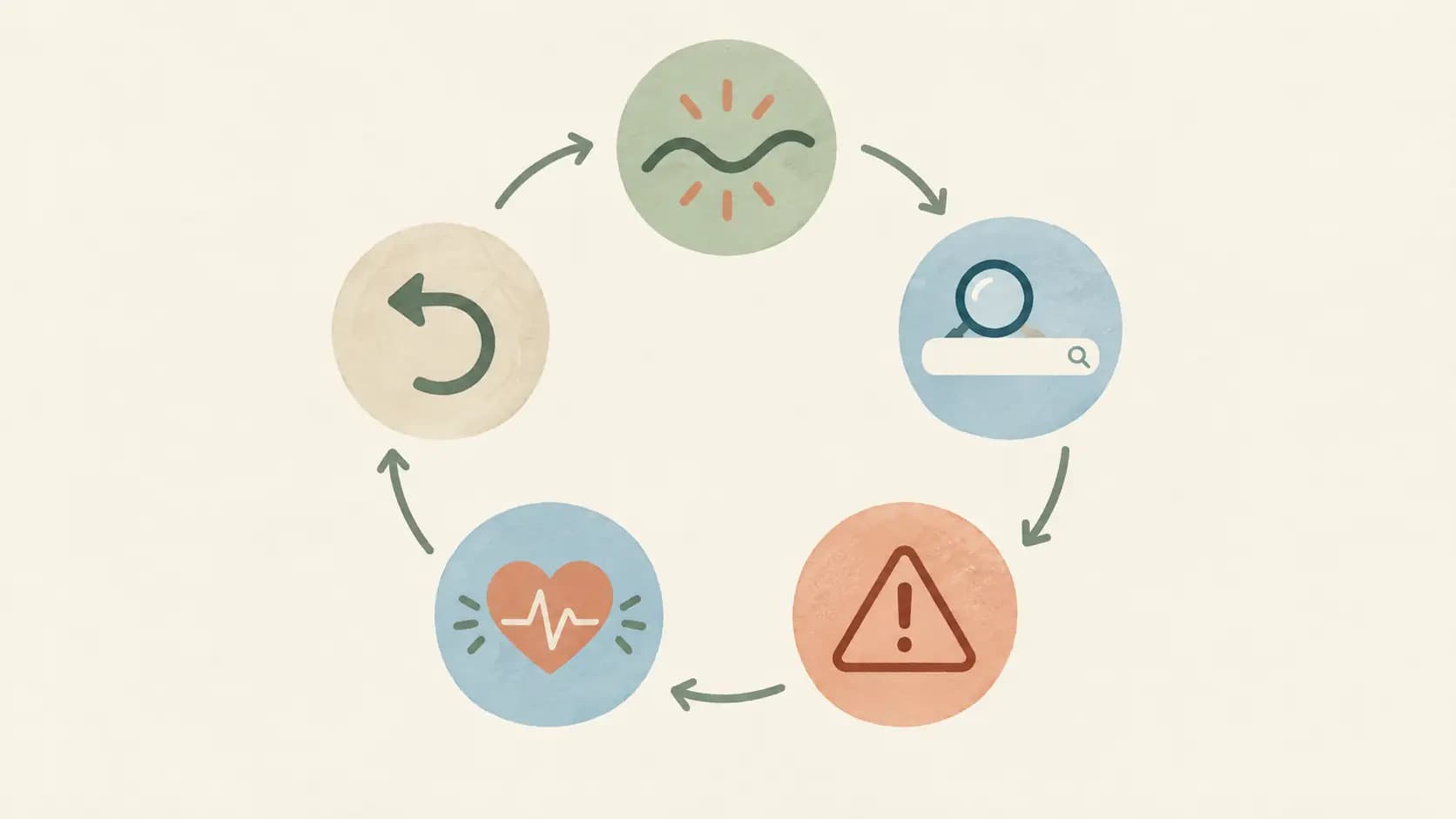
A search gives brief relief, then shows you more possibilities, so the worry grows and the urge to search returns. Top results often feature rare, serious conditions, because those are the stories people click. (Source: UNSW, 2019)
The pattern usually runs like this: you notice a sensation, search, find something frightening, feel more anxious, then search again to settle it. It’s a version of the anxiety cycle, where short-term relief keeps the worry going.
Certainty doesn’t arrive, because a search result can’t examine you. Asking people for the same reassurance works the same way.
The Centre for Clinical Interventions in Perth notes that reassurance seeking can bring short-term relief but may reinforce anxiety over time. (Source: Centre for Clinical Interventions, WA Department of Health)
Anxiety can also cause real body sensations, such as a racing heart or a tight chest. Learning about the physical symptoms that anxiety can cause can help explain why one worry creates new things to check. That loop is what keeps cyberchondria going.
Symptom searching today: Google, forums and AI chatbots
Many Australians have started asking AI chatbots about health. In a national survey published in the Medical Journal of Australia, 9.9% of 2,034 adults had asked ChatGPT a health question in the six months to mid-2024.
Of those who knew about it but hadn’t used it for health, 38.8% said they would consider it in the next six months. (Source: Ayre et al., Medical Journal of Australia, 2025)
The most common reasons were learning about a health condition (47.6%) and finding out what symptoms mean (37.4%). About 61% of users asked something that would usually need a clinician. (Source: Ayre et al., Medical Journal of Australia, 2025)
A chatbot is easy to ask again and again, which may make reassurance seeking easier. It can explain general information, but it can’t examine you or know your history. The tool is new. The pattern is the same.
Signs your searching may have tipped from careful to distressing
Use the four questions above: is it excessive, hard to control, distressing, and getting in the way? Then check whether any of these sound like you:
- You spend long stretches searching, or search the same symptom many times a day.
- You want to stop but find it hard.
- You feel more scared or on edge afterwards.
- It affects your sleep, work, study or relationships.
- You keep checking your body, such as your pulse or a lump.
- You ask family or your GP for the same reassurance again and again.
- You find it hard to trust a normal result.
Ticking a few boxes doesn’t mean you have a disorder. It’s a sign worth talking through. Health worry can overlap with generalised anxiety, which involves excessive worry about everyday matters such as health (Source: Healthdirect), and sometimes with obsessive compulsive disorder.
A GP or psychologist can help sort out what’s going on, including whether cyberchondria is part of a wider pattern of health anxiety.
What can you do when the urge to search hits?

Try delaying the search, naming the urge and choosing one trusted source with a time limit. The aim is a calmer relationship with searching, not never looking anything up.
- Notice and name it. Say to yourself, “This is the urge to check.” For a few days, jot down when, where and what you search. You’ll spot your high-risk times. (Source: UNSW, 2019)
- Delay. Wait 15 minutes before you search. Watch how the urge changes over time, rather than acting on it straight away.
- Look for a more likely explanation. An eye twitch after a long day at a screen is far more likely than the frightening result you found. (Source: UNSW, 2019)
- Pick one trusted source and set a timer. Use a government-run site such as Healthdirect for health information, or Head to Health for anxiety support. Stay away from forums, blogs and personal illness stories.
- Fill your high-risk times. If it’s usually late at night, plan something absorbing or a relaxation exercise for then.
These steps may help some people and not others. If the urge stays strong, talk to your GP or a registered psychologist.
When does a symptom deserve a real check?
Anxiety doesn’t mean nothing is wrong. A symptom that’s new, lasts or gets worse deserves a GP visit, even if you also have health anxiety. The Centre for Clinical Interventions makes the point that the issue in health anxiety isn’t whether your symptoms are real, but how you respond to them.
For anything else that’s new, ongoing or getting worse, book a GP appointment. Healthdirect also offers a free service where you can talk to a nurse or doctor about what to do next.
How can a psychologist help with health anxiety?
A psychologist can help you understand and change the thoughts and habits that keep health worries going. Cognitive behaviour therapy (CBT) is one common approach.
Understanding how CBT works helps here. It looks at the link between your thoughts, your searching, body checking and reassurance seeking, and works on cutting back on those habits step by step. Acceptance and commitment therapy (ACT) is another approach some psychologists use, with a focus on making room for uncertainty.
A UNSW trial of online CBT included 41 people with severe health anxiety, compared with 41 controls. Six online modules over 12 weeks, with phone support from a psychologist, reduced how often people searched and how upsetting it was.
It also improved their control over searching. (Source: Newby and McElroy, The Conversation, 2019) It was a small study, so treat it as encouraging, not conclusive.
You can also try free options. The Centre for Clinical Interventions health anxiety modules are designed to be worked through in order. THIS WAY UP offers a Health Anxiety program of six lessons. (Source: eMHPrac)
Results vary, and individual circumstances differ. A registered health practitioner can talk with you about what suits you. If you’re wondering about medication, that’s a conversation for your GP or a psychiatrist.
How to get started in Australia
- See your GP. Describe your physical symptoms and how much the worry is taking over. Your GP can check for physical causes and talk with you about a Mental Health Care Plan.
- Ask about a plan and rebates. A plan lets you claim Medicare rebates on psychology sessions. You don’t need a referral to see Jacob at Sage, but you do need a plan to claim a rebate. At Sage, the gap fee is $78.45 per session under a plan. Check the current fees before you book.
- Book your sessions. Jacob sees adults in East Fremantle and by telehealth across Western Australia.
- Use free support in the meantime. Beyond Blue is on 1300 22 4636, and the free modules above are there whenever you want them.
If you would like to talk through your situation with a registered psychologist in East Fremantle, Jacob at Sage Psychological Services is happy to help.
Frequently asked questions
- It’s often linked to health anxiety, where worry about illness is hard to switch off. It can also appear alongside generalised anxiety or obsessive compulsive disorder. The searching is often an attempt to get certainty or reassurance, and it tends to keep the worry going rather than settle it. A GP or psychologist can help work out what’s behind it.
- It’s a research term for distressing, excessive health searching, not an official diagnosis. The distress is real, though. It often goes with health anxiety, which a GP or psychologist can assess. If searching is affecting your sleep, work or relationships, it’s worth raising with a health professional.
- Hypochondria is an older term. In the DSM-5-TR, illness anxiety disorder is a diagnosis for intense worry about having or getting a serious illness. Cyberchondria describes the online searching that can come with these worries. Only a qualified health professional can assess whether a diagnosis fits your situation. (Source: American Psychiatric Association, DSM-5-TR, 2022)
- Start small. Note when the urge hits, delay for 15 minutes, look for a more likely explanation, then use one trusted source with a timer. Avoid forums and personal illness stories. If you can’t cut back, a GP or registered psychologist can help. Results vary, and individual circumstances differ.
- A chatbot can explain general health information, but it can’t examine you or know your history. Asking again and again for reassurance may feed the cycle. If a symptom worries you, speak to your GP. In an emergency, such as chest pain or trouble breathing, call 000.
- A psychologist can help you work on the thoughts and habits that keep health worries going, often using CBT. You don’t need a referral to see a psychologist, but a GP Mental Health Care Plan is needed to claim a Medicare rebate. Results vary, and individual circumstances differ.
- See your GP for any symptom that’s new, ongoing or getting worse, and before you assume it’s anxiety. Having health anxiety doesn’t rule out a physical cause. Call 000 for emergencies such as chest pain, trouble breathing or sudden weakness.
About the author: Jacob Jones is a registered psychologist (AHPRA PSY0002462461) at Sage Psychological Services in East Fremantle, WA.
This article is general information only and isn’t a substitute for advice from a registered health practitioner. If you’re worried about a symptom or your mental health, please speak with your GP or psychologist.