

Something sets off a wave of worry, you find a way around it, and for a while you feel fine. Then the same trigger comes back, only this time it feels a little harder to face. This looping pattern is what psychologists call the anxiety cycle, and understanding how it works is the first real step toward changing it.
Below, this article covers what the cycle looks like stage by stage, why avoidance keeps it running, and what actually helps reverse it, based on a model used across Western Australia’s public mental health system.
What this pattern actually means
This pattern is a repeating loop where anxious thoughts, physical symptoms, and avoidance keep reinforcing each other, so the anxiety never really gets the chance to settle.
Western Australia’s own Anxiety reversing the vicious cycle resource describes this loop clearly.
CCI is a specialist statewide public program that treats adults with complex anxiety, mood, and eating difficulties, and its model underpins much of the evidence-based anxiety treatment used across Australia today.
The short version is this. Anxiety itself isn’t the problem. It’s a normal response that keeps you alert to real threats. It becomes a problem when avoidance becomes the main way you manage it, because avoidance quietly teaches your brain that the feared situation was dangerous after all, even when it wasn’t.
The 5-stage anxiety cycle, step by step
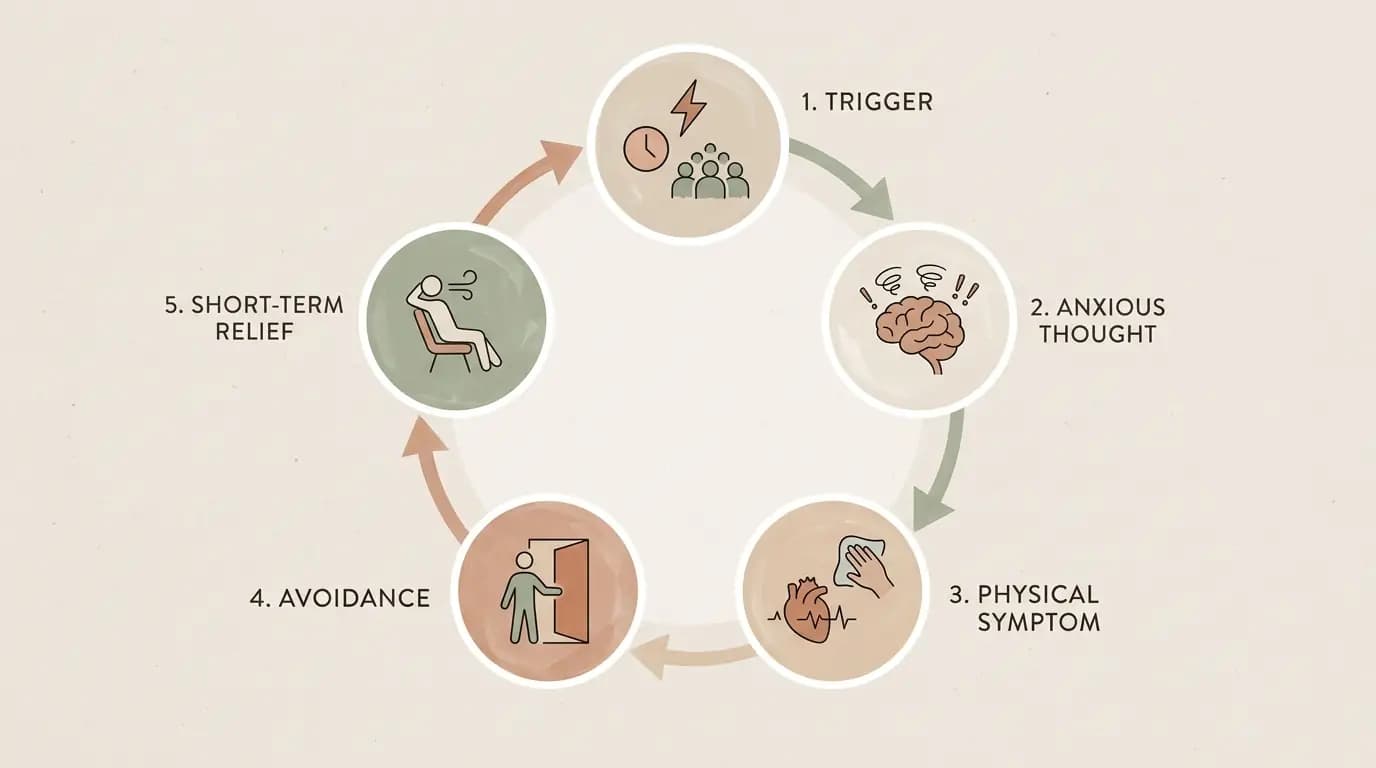
The anxiety cycle generally moves through five stages: a trigger, an anxious thought, a physical symptom, an avoidance behaviour, and a short period of relief that resets the whole pattern.
Here’s how it tends to play out, using a general, everyday example rather than any one person’s story.
- Trigger. Something happens, such as being asked to speak up in a meeting, that sets off an anxious reaction.
- Anxious appraisal. Your mind jumps to the worst-case version of events. “I’ll freeze. Everyone will notice.”
- Physical symptoms. Your body responds as if the threat were real. Your heart rate climbs, your chest tightens, your palms sweat.
- Avoidance or safety behaviour. You find a way to escape or soften the moment. You stay quiet, leave the room, or over-prepare to the point of exhaustion.
- Short-term relief, then reset. The anxiety drops for a while. But your brain has just learned that avoidance kept you safe, so the same trigger feels even more threatening next time.
None of these stages is unusual on its own. It’s the way they feed into each other, again and again, that turns a normal stress response into something that starts running your day.
Why avoidance feels like the fix (and isn’t)
Avoidance feels like it works because it does, in the short term. That relief is real, which is exactly why this pattern is so hard to break on your own.
The trouble is that relief comes at a cost. Every time you avoid something out of anxiety, your brain quietly files that situation under “dangerous,” even if nothing bad would have actually happened. Over time, the list of things you avoid tends to grow, not shrink.
This mechanism, sometimes called negative reinforcement, is also central to how CBT works and why it targets avoidance directly rather than just the anxious thoughts themselves. If you’d like to understand that process in more depth, our article on how CBT reshapes anxious thinking goes through it step by step.
Reversing the cycle: what can help break it

This loop is reversed largely the same way it was built, through repeated experience, just running in the other direction. Instead of avoiding a feared situation, you face it gradually, in a way that lets your body and mind learn it can cope.
CCI’s own model calls this “reversing the vicious cycle,” and it centres on two things: gradually confronting feared situations without leaning on safety behaviours, and building a bit more confidence each time you get through one.
This lines up closely with cognitive behaviour therapy (CBT), which is commonly recommended in Australia for managing anxiety, often as part of a GP Mental Health Treatment Plan.
CBT for the anxiety cycle usually works through two main techniques.
- Cognitive restructuring. You learn to notice an anxious thought, write it down, and honestly weigh up the evidence for and against it, rather than assuming it’s true just because it feels true.
- Graded exposure. Instead of avoiding a trigger altogether, you face it in small, manageable steps, at a pace that suits you, rather than all at once.
Use this checklist to get a sense of whether this pattern might apply to you. This isn’t a diagnostic checklist, just a general guide to reflect on.
- You avoid situations you used to manage without a second thought
- Small worries seem to snowball into much bigger ones
- Relief after avoiding something never quite lasts
- You’ve noticed yourself avoiding more things over time, not fewer
- Physical symptoms like a racing heart or tight chest show up before you’ve registered feeling anxious
None of this means something is wrong with you. It means the pattern has become familiar to your brain, and familiar patterns can be worked with. Results vary between individuals, and how long this takes depends on your own circumstances, so it’s worth discussing timeframes with your own psychologist rather than assuming a general figure applies to you.
When the cycle runs deeper: trauma and EMDR
Sometimes this pattern is tied less to a specific, current trigger and more to something further back, such as a difficult or distressing past experience.
In those cases, a psychologist may draw on approaches such as Eye Movement Desensitisation and Reprocessing, known as EMDR, or psychodynamic work, sometimes alongside Acceptance and Commitment Therapy (ACT), depending on what’s driving the pattern underneath the surface symptoms.
You can read more about EMDR therapy in Perth and how it’s used alongside other evidence-based approaches for anxiety and trauma. As with any approach, what helps depends on your own history and goals, and a first conversation with a registered psychologist is the best way to work out what’s likely to suit you.
Why this matters beyond how you feel day to day
This pattern isn’t just an individual experience. It sits inside a much larger picture of mental health in Australia, and the scale of that picture is worth naming.
The Productivity Commission’s 2020 Mental Health Inquiry estimated that mental ill-health and suicide cost Australia somewhere between $200 and $220 billion a year, once healthcare, lost productivity, and broader social costs are counted. This remains the most recent estimate of its kind, since no newer Australian inquiry has re-quantified the figure since.
That number isn’t meant to be alarming. It’s a reminder that these patterns, multiplied across millions of people, add up to something the whole country has an interest in addressing properly, not just something to manage quietly on your own.
Getting support in Perth: what it actually costs
Getting support usually starts with a conversation with your GP, and from there follows a fairly predictable path, one that most GP Mental Health Treatment Plans are built around.
- Book a longer GP appointment and explain what’s been going on, including any physical symptoms.
- Ask about a Mental Health Care Plan. If appropriate, your GP will prepare this and refer you to a psychologist, usually for an initial six sessions.
- Attend your sessions with a registered psychologist. After the first six, you return to your GP for a review before accessing further sessions.
- Claim your Medicare rebate, which is usually processed automatically after each appointment.
Cost is often the deciding factor in whether people reach out at all, so here’s how it breaks down at Sage Psychological Services.
The gap fee at Sage is kept deliberately low, well below the Australian Psychological Society’s recommended fee, so consistent support stays within reach. You can see current fees and Medicare rebate details for the most up-to-date figures.
Access is also worth thinking about earlier rather than later. AIHW’s 2024 mental health workforce data shows that, unlike most other states, Western Australia has proportionally more mental health nurses than psychologists relative to its overall mental health workforce.
That’s not a reason to worry, but it’s a reasonable argument for starting the GP conversation sooner rather than waiting until things feel unmanageable.
If you would like to talk through your situation with a registered psychologist in East Fremantle, the team at Sage Psychological Services is happy to help.
Jacob works with adults across Fremantle, Melville, Cockburn, and the wider Perth area, as well as by telehealth for clients elsewhere in WA. You’re welcome to book a session with Jacob when it suits you.
Frequently asked questions
It generally moves through five stages: a trigger, an anxious thought, a physical symptom such as a racing heart, an avoidance or safety behaviour, and a period of short-term relief that then resets the pattern. Knowing which stage you tend to get stuck in can help you work out where to start making changes.
Avoidance brings short-term relief, but it also teaches your brain that the avoided situation was genuinely dangerous, even when it wasn’t. Over time, this tends to grow the list of things that feel threatening, rather than shrinking it, which keeps the pattern going.
They’re closely related. A panic cycle is essentially the same loop playing out more intensely and quickly, often with sudden, strong physical symptoms. The same underlying pattern of trigger, symptom, avoidance, and relief applies to both, and similar approaches are used to address them.
This pattern can show up with any type of anxiety, including generalised anxiety disorder (GAD). GAD refers to a specific, ongoing pattern of hard-to-control worry across many areas of life, most days, for six months or more.
Many people work through this pattern using psychological therapy alone, such as CBT, without medication. For some people, a GP or psychiatrist may also discuss medication as part of a broader plan, but that decision sits with them, not with a psychologist, since psychologists in Australia don’t prescribe.
There’s no fixed timeframe that applies to everyone, and results vary between individuals depending on their own circumstances. Many people notice small shifts within a handful of sessions, though for others it takes longer. A registered psychologist can talk you through what’s realistic for your own situation.