

Your heart is thumping, your thoughts are racing, and you cannot think your way out of it. Grounding techniques for anxiety give you something simple to do in that moment, using your body and senses to bring your attention back to where you are. This article explains what grounding is, gives you five techniques to try, and covers when it is time to talk to a professional.
What happens in your body when anxiety peaks, and what does grounding do?
When anxiety peaks, your body reacts as if it is under threat, even when nothing dangerous is in front of you. This is the fight-or-flight response. It can bring a pounding heart, fast breathing, tight muscles and a sense of dread. Grounding is a set of simple skills that bring your attention back to the present moment through your senses, your body or your thinking.
Anxiety shows up in different ways. Over a 12-month period in 2020-22, 3.7% of Australians had panic disorder and 7.3% had social phobia (Source: ABS, 2020-22).
Others live with generalised anxiety or health anxiety, and many people have spikes that do not fit a neat label. The ABS National Study of Mental Health and Wellbeing has the full figures.
Lifeline Australia lists box breathing, reciting something in order and using your five senses as ways to ease the physical feelings of panic. Grounding will not remove anxiety, and it does not replace treatment. Some people find it gives them steadier footing while the feeling is strong.
A quick check before you start
Grounding is for anxiety, not for medical emergencies. Chest tightness and a racing heart can have a medical cause, so it helps to know when to get urgent help.
Healthdirect advises talking to your doctor after one or more panic attacks. You can also call Healthdirect on 1800 022 222. To learn more about telling the two apart, read our post on how to tell a panic attack from a heart attack.
Five grounding techniques for anxiety to try while it is peaking
Physical grounding techniques use your body and senses, while mental ones give your thinking something steady to do. Try each one when you are calm first, then keep the ones that suit you.
1. The 5-4-3-2-1 senses check

This well-known grounding exercise for anxiety uses all five senses. Go slowly through these steps:
- Look: name five things you can see.
- Touch: notice four things you can feel, such as your clothes or the chair beneath you.
- Listen: pick out three sounds.
- Smell: notice two smells. If you cannot find any, think of two smells you like.
- Taste: notice one taste, or take a sip of water.
2. Box breathing
Breathe in for a count of four, hold for four, breathe out for four, then hold for four. Repeat a few times. If holding your breath feels uncomfortable, skip the holds and make your out-breath a little longer than your in-breath.
3. Feet and body anchoring
Press your feet into the floor and notice the pressure. Push your palms together for a few seconds, then let go. Hold a cool glass of water and notice how it feels in your hands.
4. Describe an object
Pick something nearby, like a mug or a pen. Describe it to yourself in detail: its colour, shape, weight and texture. This gives your mind a small task that is not about the worry.
5. A steady phrase or counting back
Count backwards from 100 in threes, or repeat a short phrase such as “I am here, and I am breathing.” If your mind wanders, start again without judging yourself.
Some people find these skills help during a spike. Results vary and individual circumstances differ, so talk with a registered health practitioner about what may suit you.
Which grounding technique suits which moment?
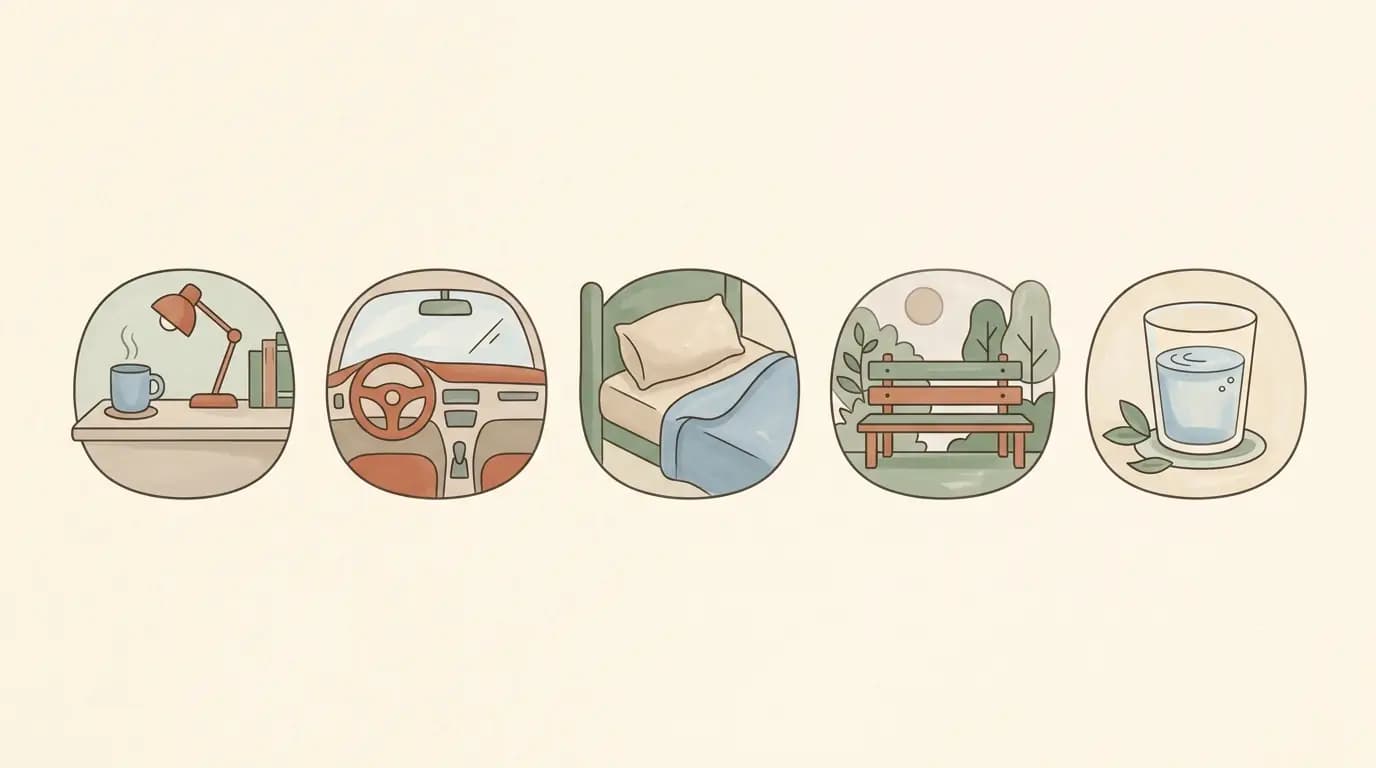
Different grounding techniques for anxiety suit different moments, so match the skill to where you are and how much attention you can spare. Use this table as a starting point.
If you are driving and anxiety makes it hard to concentrate, pull over when you can before you try anything else.
Is grounding the same as avoidance?
No. Grounding helps you stay present with a hard moment, while avoidance means leaving or putting off the thing that worries you.
Avoidance can bring quick comfort, but it often keeps anxiety going over time. Our post on how avoidance keeps anxiety going explains why this happens. Used well, grounding helps you stay in the room, finish the task or have the conversation with steadier footing.
The line can blur. If you only use grounding to get out of situations, or your world is getting smaller, that is worth talking through with a psychologist. Approaches such as cognitive behaviour therapy (CBT) look at the thoughts and habits that keep anxiety going.
When does grounding not help, or feel worse?
Grounding does not suit everyone. If focusing on your body or senses leaves you more distressed, numb or detached, stop and choose something gentler.
This can happen with a history of trauma or post-traumatic stress, or when you tend to feel disconnected from yourself (dissociation). A few adjustments may help:
- Keep your eyes open and look around the room.
- Choose neutral objects, not ones linked to difficult memories.
- Keep it short, and stop if it feels worse.
- Focus on something outside you, such as a sound, rather than your breathing or heartbeat.
Blue Knot Foundation, Australia’s national centre of excellence for complex trauma, offers a general-public guide that includes grounding exercises. Where trauma is part of the picture, a psychologist can work at your pace and may use approaches such as EMDR. You can read about support for trauma and post-traumatic stress.
How do you build a grounding habit before the next peak?
Practise grounding when you are calm, so the skills feel familiar when anxiety rises. Two minutes a day is enough to start.
Pick one technique and do it at the same time each day, such as while the kettle boils. Rate your distress from 0 to 10 before and after, and jot it down. Over a few weeks you can see which techniques suit you.
Practising grounding techniques for anxiety also helps you spot early signs, like a tight jaw or shallow breathing. Naming the pattern when you notice it, such as “here is that tight jaw again”, can help you step back before the feeling builds.
When is it time to talk to a GP or psychologist?
It is worth talking to a GP or registered psychologist if anxiety is frequent, affects your sleep, work or relationships, or leads you to avoid things. You do not need to wait for a crisis.
Many people do reach out. In 2020-22, 45.1% of Australians with a mental disorder in the previous 12 months saw a health professional for their mental health (Source: ABS, 2020-22). AIHW data shows 102 patients per 1,000 people received Medicare mental health services in 2024-25, up from 94 a decade earlier (Source: AIHW, 2024-25).
Check whether any of these sound familiar:
- Anxiety on most days for several weeks
- Trouble sleeping because your mind will not settle
- Avoiding people, places or tasks
- Panic attacks that keep returning, or fear of the next one
- Physical symptoms such as a racing heart or tight chest (see your GP promptly if these worry you)
- Feeling low or flat as well as anxious
This list is not a diagnosis. Here is how getting started works in Australia:
- See your GP. Book a longer appointment and describe what you notice, including sleep and mood.
- Ask about a Mental Health Treatment Plan (often called a Mental Health Care Plan). If your GP thinks it suits you, they prepare it and refer you to a psychologist.
- Choose a psychologist. Look for someone registered with AHPRA. A Medicare rebate may apply under the Better Access initiative, and you pay the difference between the fee and the rebate. Check fees and rebates before you book.
- Attend your first session. You talk about what brought you in and what you would like to change.
At Sage, you do not need a referral to book, but you need a GP plan to claim a rebate. Healthdirect also points to online programs for panic, such as Panic Stop! and THIS WAY UP.
Jacob Jones is a registered psychologist who sees adults in East Fremantle, for people across Fremantle, Melville and Cockburn, and offers telehealth across Western Australia.
He supports adults with anxiety and panic through approaches that include CBT, and you can read about anxiety therapy in Perth. If you would like to talk through your situation with a registered psychologist in East Fremantle, the team at Sage Psychological Services is happy to help.
Frequently asked questions
- It is a sensory exercise that moves your attention away from anxious thoughts and into the room. You name five things you can see, four you can feel, three you can hear, two you can smell and one you can taste. Go slowly with each sense. Some people find it a useful starting point, and results vary.
- Start with one simple technique, such as slow breathing, pressing your feet into the floor or the 5-4-3-2-1 check. Keep your eyes open and your attention on something in the room. If you have chest pain or any doubt about your symptoms, call 000. If attacks keep coming back, speak with your GP.
- It is a quick grounding exercise. Name three things you can see, listen for three sounds, and touch or move three things around you, such as your hands, a pen or your feet. It gives your attention somewhere to go. It is a coping skill, not a treatment.
- There is no set time. Some people notice a change within minutes, while others need more practice or find a different technique suits them better. Results vary and individual circumstances differ. If anxiety keeps coming back or is affecting your daily life, talk with a GP or registered psychologist about what may suit you.
- They can for some people, especially those with a history of trauma or a tendency to feel detached from themselves. If a technique increases your distress, stop and try something gentler, like looking around the room or holding a cool glass of water. A psychologist can help you find an approach that suits you.
- No. Grounding is a coping skill for hard moments, and it does not address why anxiety keeps showing up. A registered psychologist can help you understand your patterns and work on them with approaches such as CBT. If anxiety is frequent or affecting your life, speak with your GP or a registered psychologist.
- You do not need a referral to see a psychologist privately, but you need a GP-prepared Mental Health Treatment Plan to claim a Medicare rebate. A rebate does not always cover the full fee, so ask about costs before you book. Your GP can explain whether a plan suits you.
This article is general information only and is not a substitute for advice from a registered health practitioner. If you need support right now, call Lifeline on 13 11 14, Beyond Blue on 1300 22 4636 or emergency services on 000.