
It is five minutes before a big meeting, or two in the morning, and your chest feels tight. Your heart is racing, and someone tells you to “just breathe”. You try, and it either does nothing or makes you feel more panicky.
Breathing exercises for anxiety are a simple skill that some people find useful, but they are not a fix for everything. This guide explains what Australian sources say, gives you four techniques step by step, covers when breathing can backfire, and shows how to get support.
Do breathing exercises for anxiety actually help?
They may help some people ease the physical side of anxiety, but the evidence for any single technique is limited. Think of breathing as a skill to try, not a proven fix.
Better Health Channel’s guide to breathing says shallow over-breathing can prolong anxiety by making the physical symptoms of stress worse. It adds that controlling your breathing can help improve some of those symptoms (Source: Better Health Channel, Victorian Department of Health, page reviewed 2015).
Healthdirect also lists breathing exercises among the ways to manage panic attacks when they happen (Source: Healthdirect, accessed October 2026).
A 2023 systematic review in Frontiers in Psychiatry (authors from RMIT University, Austin Health and Chinese institutions) looked at ten anxiety guidelines that included complementary approaches.
Seven included applied relaxation, a structured relaxation training method that is not the same as the breathing exercises below, and the support for it varied (Source: Frontiers in Psychiatry, 2023).
Health psychologist Dr Moira Junge says that in her experience and in the research literature, no one breathing exercise is better than another. She suggests combining breathing with other supports such as CBT, sleep and exercise (Source: Healthylife, 2023). Results vary and individual circumstances differ, so speak with a registered health practitioner about what may suit you.
What happens to your breathing when anxiety rises?
When you feel under threat, your breathing changes as part of the fight-or-flight response. Anxious people typically take small, shallow breaths high in the chest, which can make the physical symptoms of stress feel worse (Source: Better Health Channel, Victorian Department of Health, page reviewed 2015).
The physical side of anxiety is real and unpleasant, but it is not a sign you are doing something wrong. If you have chest pain and any doubt, follow the urgent symptoms box above first. Once you have been checked, our post on what a panic attack really feels like explains more.
Anxiety is common in Western Australia. In 2020 to 2022, 18.2% of people aged 16 to 85 in WA had an anxiety disorder in the previous 12 months (Source: ABS, 2020 to 2022).
Four breathing exercises to try, step by step
Try each exercise when you are calm first, so it feels familiar. The counts are a guide, so shorten them if they feel long. Keep your out-breath a little longer than your in-breath, and skip any breath holds you find uncomfortable. If you would like a voice to follow, Beyond Blue’s guided relaxation exercises include audio for relaxed breathing.
1. Belly (diaphragmatic) breathing
This slow technique moves your breathing from your upper chest down into your belly. It is a simple place to start.
- Sit or lie down comfortably. Rest one hand on your chest and the other on your belly.
- Breathe in gently through your nose. Let your belly rise while your chest stays fairly still.
- Breathe out slowly and feel your belly fall.
- Repeat for a few minutes.
2. Longer out-breath breathing
This one has no breath holds, so it is easy to do quietly at your desk. It also suits moments when you want something discreet.
- Breathe in through your nose for a count of four.
- Breathe out slowly for a count of six.
- Repeat several times. If six feels long, try five.
3. Box breathing
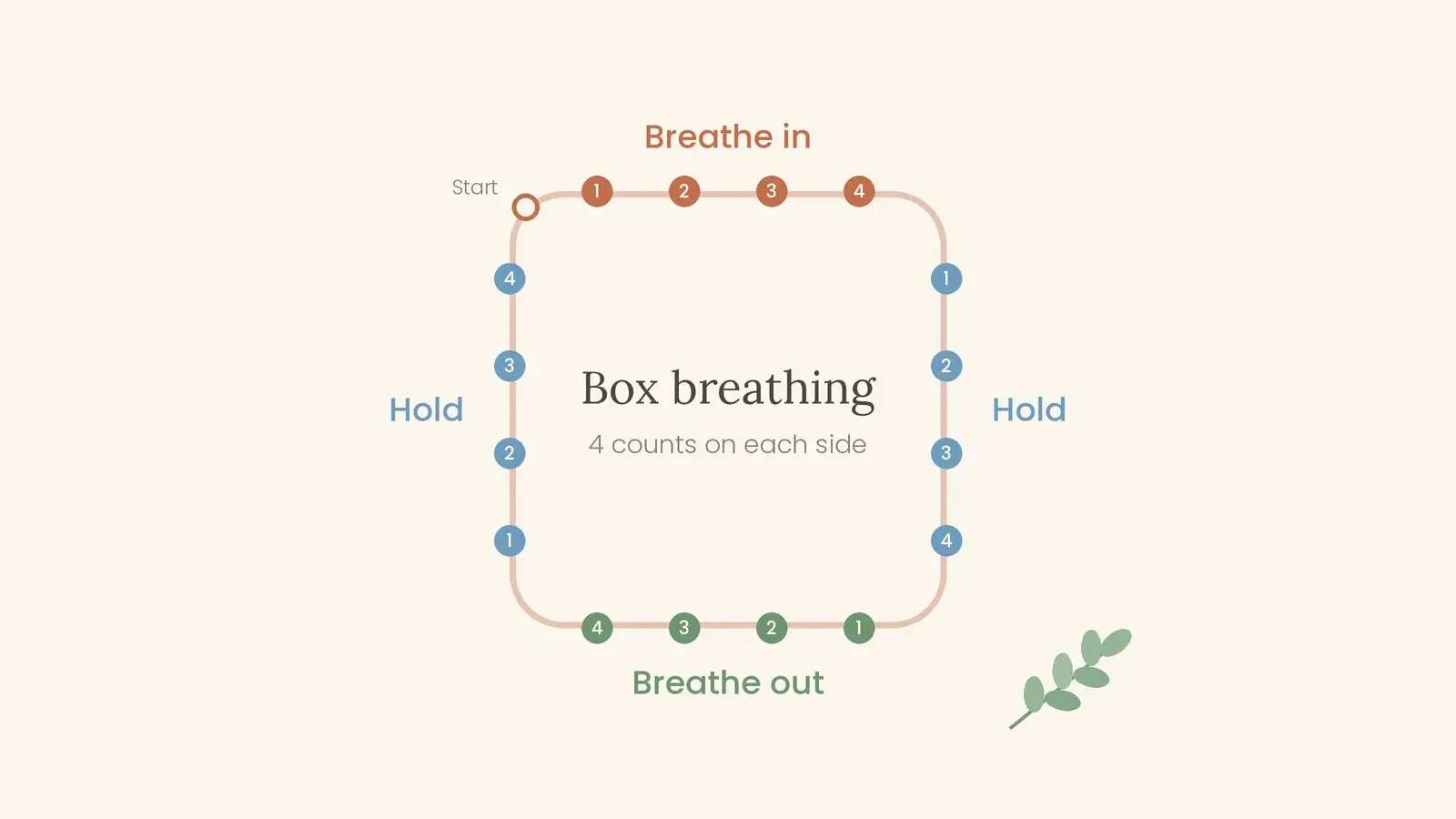
Box breathing uses four equal counts, like the sides of a square. If the holds feel uncomfortable, skip them and make your out-breath a little longer.
- Breathe in for a count of four.
- Hold for four.
- Breathe out for four.
- Hold for four, then repeat a few rounds.
4. 4-7-8 breathing
Dr Andrew Weil, a US doctor, developed this longer-exhale pattern (Source: Healthylife, 2023). If the counts feel long, shorten them but keep the out-breath longer than the in-breath.
- Breathe in quietly through your nose for four.
- Hold for seven.
- Breathe out through your mouth for eight, with a soft whoosh.
- Repeat for four cycles.
How do you choose between them?
Choose the one that feels easiest when you are anxious. This table is a starting point, and it is fine to try a few before one feels right.
How do you practise so it is there when you need it?
Practise for a few minutes when you are calm, so the skill feels familiar before anxiety rises. Dr Junge recommends regular practice for this reason (Source: Healthylife, 2023).
Pick one exercise and attach it to something you already do, like waiting for the kettle. Rate your distress from 0 to 10 before and after, and jot it down.
Over a few weeks you may see which breathing exercises for anxiety suit you. Results vary and individual circumstances differ, so a GP or registered psychologist can help if you are unsure what suits you.
When do breathing exercises make anxiety feel worse?
For some people, focusing on the breath increases panic or dizziness. If that happens, stop and try something else. Breathing exercises for anxiety do not suit everyone.
Better Health Channel notes that some people find concentrating on their breath provokes panic and hyperventilation, and it suggests finding another way to relax (Source: Better Health Channel, page reviewed 2015).
Check with your GP before trying breath holds if you have asthma, a heart or lung condition, or are pregnant. Never do breath holds while driving, swimming or in the bath.
If focusing on your breath makes things worse, using your senses may suit you better. Our guide to grounding techniques for anxiety explains how. Where trauma is part of the picture, a psychologist can help you find an approach that suits your pace.
Breathing is a skill, not the whole treatment
Breathing may help with how anxiety feels in your body. Talking therapy, such as CBT, works on the thoughts and habits that can keep anxiety going. The RANZCP guidelines for panic disorder, social anxiety disorder and generalised anxiety disorder stress psychoeducation, lifestyle change and CBT, and include simple instructions for slow breathing (Source: RANZCP, 2018). You can read about cognitive behaviour therapy (CBT) on our site.
One thing to watch is whether breathing becomes a way to get out of situations. Avoidance can bring quick relief but often keeps anxiety going over time. If your world is getting smaller, that is worth talking through with a psychologist.
When should you see a GP or psychologist, and how do you start in Australia?
Consider talking to a GP or registered psychologist if anxiety is frequent, disrupts your sleep, work or relationships, or leads you to avoid things. You do not need to wait for a crisis.
In 2020 to 2022, 12.4% of Australians aged 16 to 85 saw a GP and 7.8% saw a psychologist for their mental health in the previous 12 months (Source: ABS, 2020 to 2022). Among people with a 12-month mental disorder, 21.3% saw a psychologist.
How to get started in Australia
- See your GP. Book a longer appointment and describe what you notice, including sleep and mood.
- Ask about a Mental Health Care Plan. It is also called a GP Mental Health Treatment Plan. If your GP thinks it suits you, they prepare it and refer you to a psychologist.
- Choose a psychologist registered with AHPRA. A Medicare rebate may apply under Better Access, and you pay the difference. Check fees and rebates before you book.
- Attend your first session. You talk about what brought you in and what you would like to change.
At Sage you do not need a referral to book, but you need a GP plan to claim a rebate. You can also call Healthdirect on 1800 022 222 for health advice.
If you would like to talk through your situation with a registered psychologist in East Fremantle, Sage Psychological Services is happy to help. Telehealth is available across Western Australia, and you can read more about anxiety therapy in Perth.
Frequently asked questions
- They may help some people ease physical symptoms such as a racing heart. The evidence for any one technique is limited, and no technique has been shown to be better than another. Think of them as a coping skill, not a treatment. Results vary and individual circumstances differ. If anxiety is frequent, speak with a GP or registered psychologist.
- Start with the one that feels easiest, often slow belly breathing or a longer out-breath with no holds. Try it when you are calm. Box breathing and 4-7-8 add breath holds, which some people find uncomfortable. If an exercise leaves you dizzy or more anxious, stop and try something else.
- Dr Moira Junge, a health psychologist, says that in her experience and in the research literature, no one breathing exercise is better than another (Source: Healthylife, 2023). Box breathing uses equal counts, while 4-7-8 uses a longer hold and out-breath. Choose the one that feels more comfortable, and skip the holds if they make you uneasy.
- There is no set time. Some people notice a change within a few minutes, while others need more practice or find a different skill suits them better. Results vary and individual circumstances differ. If anxiety keeps returning, talk with a GP or registered psychologist about what may suit you.
- Breathing exercises may give you something steady to focus on while a panic attack passes, but they do not work for everyone. Healthdirect lists breathing exercises among the ways to manage attacks when they happen. If you have chest pain and any doubt, call triple zero (000) and ask for an ambulance.
- Yes, for some people. Focusing on the breath can increase panic, and breath holds can feel like air hunger. If you notice dizziness, tingling or rising panic, stop and return to normal breathing. A gentler skill, such as grounding, may suit you better. A GP or psychologist can help if this keeps happening.
- You do not need a referral to see a psychologist privately, but you need a GP-prepared Mental Health Care Plan to claim a Medicare rebate. A rebate may not cover the full fee, so ask about costs before you book. Your GP can explain whether a plan suits you.
This article is general information only and is not a substitute for advice from a registered health practitioner. Results vary and individual circumstances differ.