

You might lie awake with a racing mind, then wake up feeling flat and heavy. If you live with anxiety and depression together, it can be hard to tell which one is driving, or where to start. This guide explains how the two overlap, what Australian data shows, and how to take a first step through your GP and a registered psychologist.
Can you have anxiety and depression at the same time?
Yes. Anxiety and depression are separate conditions, but they often occur together. Clinicians call this comorbidity, which simply means two conditions at the same time.
Anxiety includes generalised anxiety disorder, panic disorder and social anxiety disorder. Depression includes a depressive episode (often called major depressive disorder) and persistent depressive disorder. Some people notice symptoms of both without fitting neatly into one label.
The numbers show how common each one is. About 7.4% of Australian adults had a mood disorder and 15.7% had an anxiety disorder in the 12 months before the 2020 to 2022 national survey (Source: Slade et al., Australian and New Zealand Journal of Psychiatry, 2025). This study counts disorders slightly differently from other ABS headline figures.
Having both is also common. In the ABS National Health Survey 2017-18, around 1.5 million Australians (6.1%) reported both an anxiety-related condition and depression or feelings of depression (Source: ABS, 2017-18). None of this tells you whether you have either condition. Only an assessment can do that.
What anxiety and depression feel like alone and together
Anxiety tends to feel like too much alertness, and depression like too little energy. When both are present, you can feel wired and worn out at the same time.
Psychologists use the word rumination for going over the same thoughts again and again. Anhedonia means a loss of pleasure or interest. Insomnia and fatigue appear in both columns.
You may recognise yourself in more than one column. This table is a guide, not a diagnosis.
Why the two so often show up together
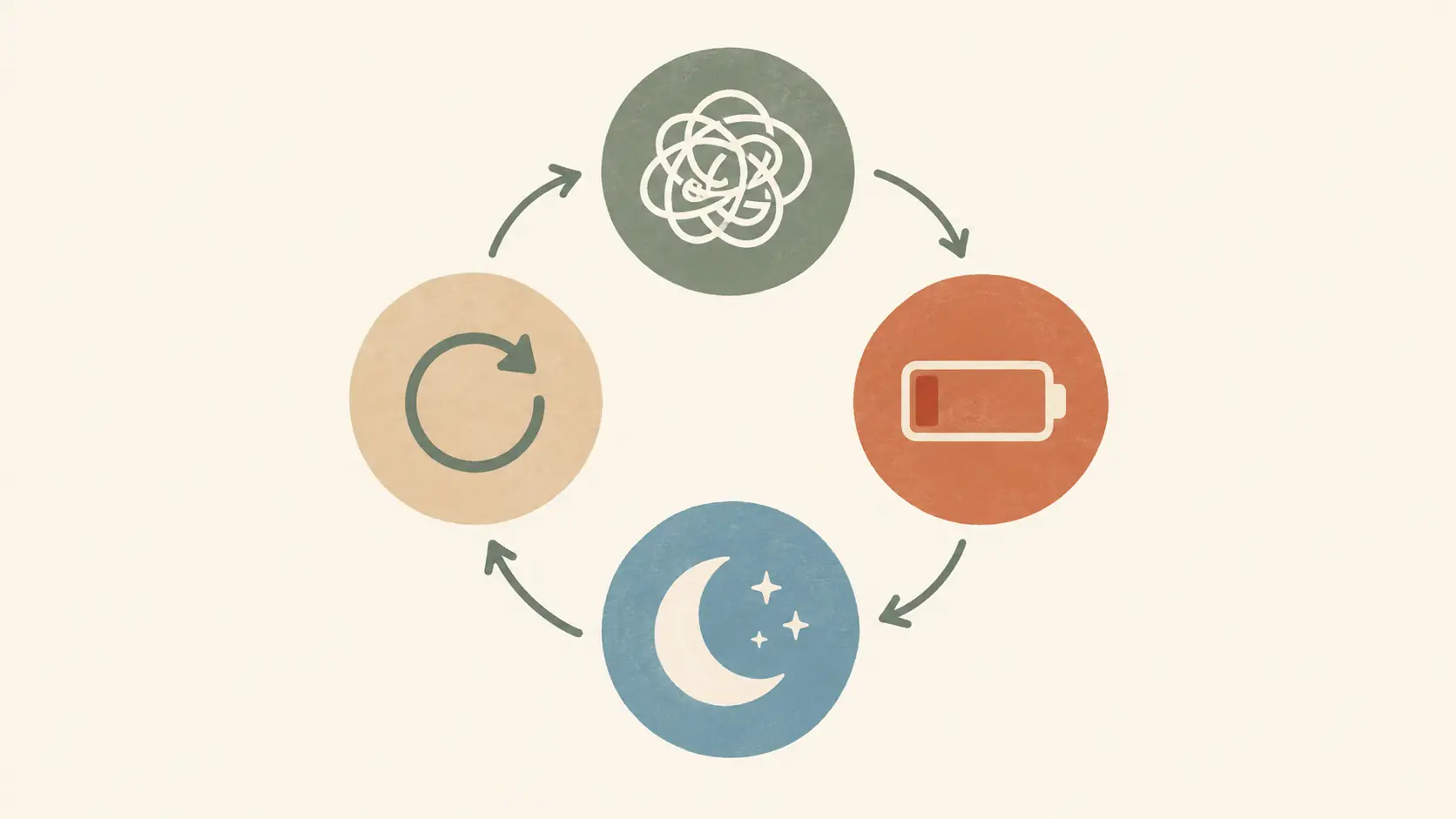
Anxiety and depression often feed each other in a loop. Worry leads to avoidance and exhaustion, which leads to withdrawal and low mood, which leads to more worry.
Shared pressures can play a part, such as long stress, poor sleep, loss and ongoing health problems. About 1.7 million Australians (8.4%) had both a 12-month mental disorder of any type and a selected physical condition (Source: ABS National Study of Mental Health and Wellbeing, 2020-22). That does not show one thing causes the other. You can read more about how the anxiety cycle works, and why avoidance keeps anxiety going.
When worry comes first
Long-term worry wears you down. You may avoid things, cancel plans and sleep badly. Over time, life can get smaller, and a low mood can set in.
When low mood comes first
Depression drains energy and confidence. Everyday tasks start to feel risky, so worry about coping, letting people down or the future can creep in. Some people never find a clear order, and that is fine.
How heavy this can get
Living with both can add up, and daily life can take more effort. The figures below describe groups of people, not you.
Among Australian adults with a 12-month mood disorder, 46.4% were classed as severe. This figure covers mood disorders on their own, not people with both conditions (Source: Slade et al., Australian and New Zealand Journal of Psychiatry, 2025).
Australians aged 16 to 24 had about 1.4 times the risk of having more than one disorder in 2020 to 2022 compared with the same age group in 2007 (Source: Teesson et al., Australian and New Zealand Journal of Psychiatry, 2025).
Age matters too. Depression or anxiety was reported by 22% of people aged 15 to 34, compared with 15% of those aged 55 and over (Source: AIHW, citing ABS 2021). For wider context, see the national mental illness data from the AIHW.
Signs it is time to talk to someone
If low mood or worry has lasted for weeks and is getting in the way of life, speak with a GP or registered psychologist. You do not need to know which condition it is first.
Patterns worth acting on:
- Worry or low mood on most days for several weeks
- Sleep that is badly disrupted, either too little or too much
- Pulling away from friends, family or things you once enjoyed
- Trouble concentrating or making decisions at work or home
- Using alcohol or other substances more to cope
- Physical symptoms, such as a racing heart or constant tiredness, that a doctor has not yet checked
- Feeling hopeless, or like a burden to others
What can help when you have both
A GP or registered psychologist can look at both conditions together when making a plan. Australian mood disorder guidance from the RANZCP includes advice on managing anxiety alongside low mood (Source: RANZCP, 2020).
Therapy with a psychologist
Cognitive behaviour therapy (CBT) looks at the links between your thoughts, feelings and actions. For low mood, CBT often includes behavioural activation, where you rebuild small, doable activities step by step. For anxiety, you gradually face what you have been avoiding, at a pace you agree on.
Talking to your GP about medication
Some people discuss medication with their GP or a psychiatrist. This is a medical decision, and psychologists do not prescribe. Your GP can also check your physical health and may use questionnaires such as the PHQ-9, GAD-7 or K10.
Free and low-cost starting points
The free Depression-Anxiety program is CBT-based and designed for adults 18 and over who want to manage both sets of symptoms together. It is listed on Healthdirect and Head to Health (Source: Healthdirect, accessed October 2026).
The Medicare Mental Health Phone Service on 1800 595 212 is a free call for information on Medicare Mental Health Centres (Source: Department of Health, Disability and Ageing, 2025). Results vary and individual circumstances differ, so speak with a registered health practitioner about what fits you.
What therapy with a registered psychologist can look like
Therapy usually starts with understanding your story, then agreeing on an approach with you. At Sage Psychological Services, Jacob Jones most often draws on CBT for low mood and worry. Where problems link back to earlier experiences or long-standing patterns, he may also use schema therapy or psychodynamic work.
You see the same psychologist each time, at a pace that feels manageable. You can read about depression counselling in Perth on the practice website. Jacob sees adults in East Fremantle, within reach of Fremantle, Melville and Cockburn, and by telehealth across Western Australia.
How to get started in Australia

A GP appointment is the usual first step if you want to use Medicare. Under Medicare’s Better Access initiative, your GP decides whether you are eligible, and a rebate is not guaranteed.
- Book a GP appointment. Say you want to talk about your mental health, and mention both worry and low mood.
- Ask about a Mental Health Treatment Plan, often called a mental health care plan. Your GP assesses whether you have a mental disorder that needs at least a moderate level of support. The plan must come from a GP at your MyMedicare practice or your usual medical practitioner (Source: Department of Health, Disability and Ageing, 2025).
- Take your referral to a psychologist. You can take it to any eligible psychologist of the type named on the referral, even if the referral names someone else. Registered psychologists provide focussed psychological strategies under Medicare.
- Book a first session. Ask about approach, fees and telehealth.
- Review with your GP. Your psychologist reports back to your GP, who reviews your progress before any further referral.
Before your GP visit, it helps to note:
- How long you have felt this way, and what changed around then
- How worry and low mood affect your sleep, work, appetite and relationships
- How much alcohol or other substances you use
- What you have tried, and what has or has not helped
- Any thoughts of self-harm or suicide, which are important to tell your GP
If you would like to talk through your situation with a registered psychologist in East Fremantle, Sage Psychological Services is happy to help.
Frequently asked questions
- No, they are separate conditions with different main features. Anxiety centres on worry, fear and feeling on edge, while depression centres on low mood, loss of interest and low energy. They share symptoms such as poor sleep and trouble concentrating, which is why they are easy to mix up. A GP or registered psychologist can help sort out what you are experiencing.
- Anxiety does not automatically turn into depression, but the two are linked. Long-term worry can lead you to avoid things, sleep badly and pull back from people, and for some people low mood follows. The order can go either way. If you notice your mood dropping, a GP can talk it through with you.
- Depression can sit alongside anxiety, and for some people worry grows once energy and confidence drop. The two often occur together, but that does not prove one causes the other. Each person’s pattern is different. A registered psychologist can help you look at what came first for you and how each affects your days.
- You cannot know for sure from symptoms alone, and online checklists are not a diagnosis. A GP or registered psychologist can ask about your symptoms, how long they have lasted and how they affect daily life. They may use questionnaires such as the PHQ-9, GAD-7 or K10. You do not need to work it out before asking for help.
- Yes, a psychologist can work on both together. Approaches such as CBT look at the links between thoughts, feelings and behaviour, which are involved in worry and low mood. Your psychologist will explain the plan and adjust it with you. Results vary and individual circumstances differ, so talk with a registered health practitioner about what suits you.
- That is a decision for you and your GP or psychiatrist, and some people use therapy, some use medication and some use both. A psychologist does not prescribe medication but can work alongside your doctor. Do not start or stop any medication without medical advice. Your GP can talk through the options for your situation.
- Possibly, if your GP assesses that you have a mental disorder needing at least a moderate level of support and prepares a Mental Health Treatment Plan and referral. The plan must come from a GP at your MyMedicare practice or your usual medical practitioner. Your GP decides eligibility, and a rebate is not guaranteed. Telehealth may be an option for some sessions (Source: Department of Health, Disability and Ageing, 2025).
This article is general information only and is not a substitute for advice from a registered health practitioner. If you are worried about your health, speak with your GP or a registered psychologist.