
Your shoulders tighten, your sleep breaks and your stomach turns before you know why. Someone online says “the body keeps the score,” and you wonder how trauma is stored in the body. This guide covers what the phrase means, what Australian research shows and when to speak to your GP or a registered psychologist.
Content note: this article talks about trauma in general terms only, with no graphic detail. Pause whenever you need to.
What “the body keeps the score” means, and what it doesn’t
The phrase is the title of psychiatrist Bessel van der Kolk’s 2014 book, The Body Keeps the Score. It points to how stress and trauma can affect your body as well as your mind.
The book became hugely popular, and many people find the phrase puts words to something they feel. But it is a metaphor, and some memory researchers disagree with how the idea is used. We look at that debate further down.
Reading the book is not a treatment. If it has left you with questions, a GP or registered psychologist can talk them through with you.
How trauma is stored in the body starts with your stress response
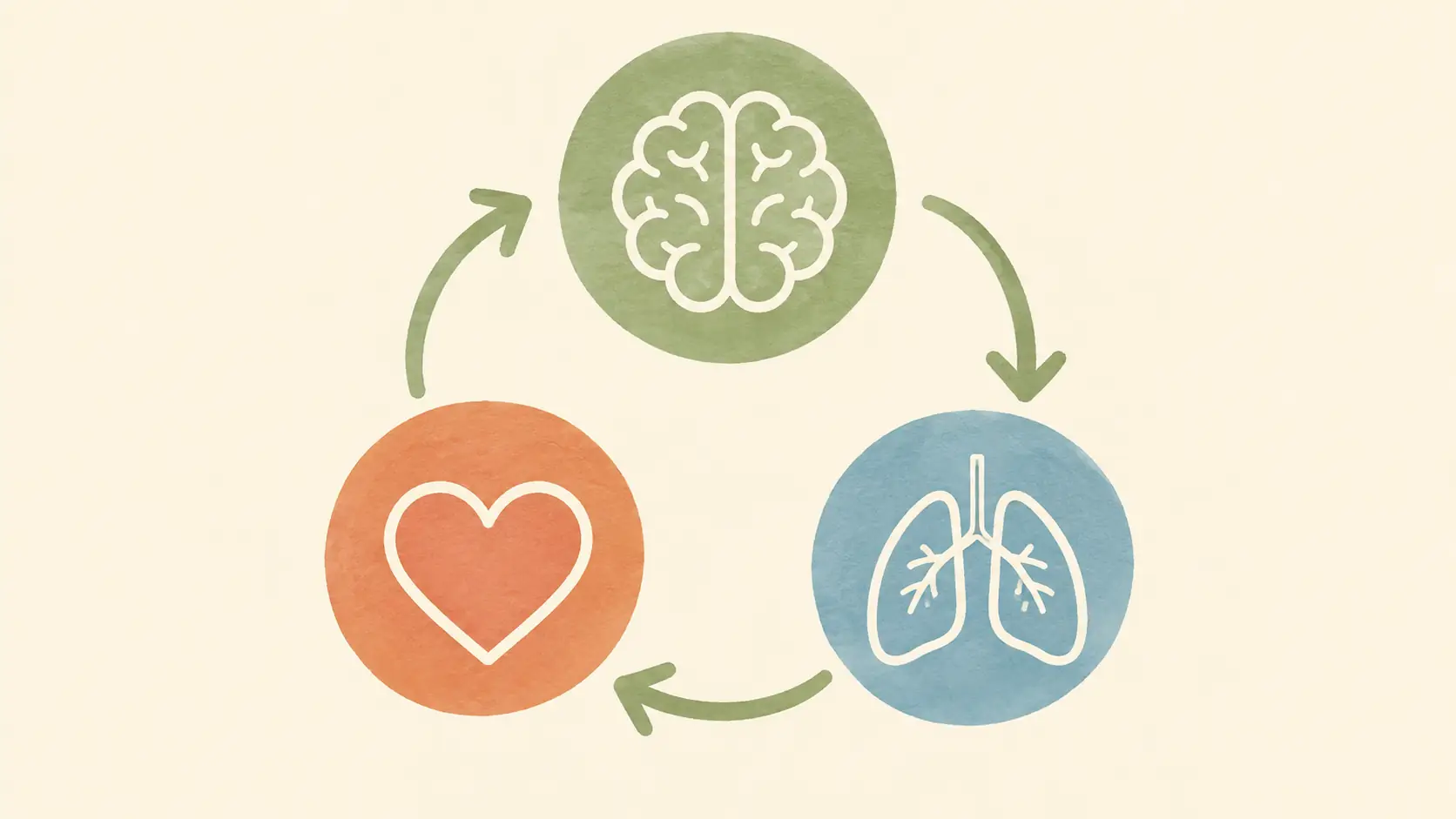
When people say trauma is “stored” in the body, they usually mean lasting changes in the stress response, learned reactions and memory. It does not mean an experience sits inside a muscle.
When you sense a threat, your autonomic nervous system switches on. Adrenaline and cortisol rise, your heart speeds up and your muscles tense (Source: Almeida and van Golde, The Conversation, 2026). You might fight, flee or freeze, often before you have time to think.
After most frightening events, the alarm settles. For some people it stays on, and the brain keeps reading reminders as danger. The body then reacts again with a racing heart, a flinch or a tight stomach.
Anxiety causes many of the same sensations. You can read about the physical symptoms of anxiety you might not recognise.
How trauma can show up in the body long after
Trauma can show up as being easily startled, poor sleep, muscle tension, strong body reactions to reminders and, for some people, widespread pain. Many other things cause these too.
Other signs include feeling constantly on guard (hypervigilance), intrusive memories with a physical reaction, and feeling numb or detached (dissociation). Some people also become more alert to, or alarmed by, sensations inside the body. That sensing is called interoception.
Pain is one area researchers have studied. An Australian evidence summary found a small link between PTSD symptoms and chronic widespread pain, based on moderate to high quality evidence.
It also found medium-sized increases in fibromyalgia and widespread pain after trauma exposure, with or without PTSD, based on moderate to low quality evidence (Source: NeuRA, 2021).
Veteran studies point the same way. PTSD in Australian Vietnam War veterans was linked to health conditions in several body systems, independent of trauma exposure (Source: Medical Journal of Australia, 2017).
A review of serving Australian Defence Force members found PTSD rates of 2 to 8 per cent on structured interviews, with links to conditions such as musculoskeletal disorders (Source: Tomic et al., 2025). These groups may not match your situation.
Many conditions cause these symptoms. A GP can check for medical causes before anyone links them to trauma.
How common is trauma in Australia, and what is it linked to?
Trauma is common here. A University of Sydney-led study found 42 per cent of Australian adults experienced a potentially traumatic event in childhood (Source: Barrett et al., Australian and New Zealand Journal of Psychiatry, 2025).
The study used national survey data from 15,893 people (2020 to 2022). Those adults had a 50 per cent higher risk of a mental health or substance use disorder, and the study found links with conditions such as asthma and arthritis.
The 2025 University of Sydney study summary explains the findings. The sample left out people experiencing homelessness, people in prison and remote First Nations communities.
The Australian Child Maltreatment Study surveyed 8,503 people aged 16 and over. About 62 per cent reported at least one type of child maltreatment (Source: Higgins et al., Medical Journal of Australia, 2023).
Among people who experienced maltreatment, 48 per cent met diagnostic criteria for one of four mental disorders (depression, alcohol use disorder, generalised anxiety disorder or PTSD), compared with 21.6 per cent of those who did not (Source: Scott et al., Medical Journal of Australia, 2023).
These studies ask about the past at one point in time. They show links, not causes. They do not mean any particular illness will follow for you.
Is trauma really “stored” in the body? What researchers debate
Researchers agree that stress can change hormones and affect other body systems (Source: Almeida and van Golde, The Conversation, 2026). They disagree about whether memories themselves are “stored” in the body.
Some of what you remember is a story you can tell, called explicit memory. Some are learned reactions that fire without words, such as flinching at a sound. That second kind, implicit memory, helps explain why a body can react before you recall why. It is not the same as hidden memories waiting in a muscle.
Memory researchers Andressa Almeida and Celine van Golde wrote in 2026 that the book rests on a more contested claim: that traumatic memories live in the body, out of reach of conscious recall.
They warn this echoes the repressed memory debates of the 1990s, and that some therapies can create false memories (Source: Almeida and van Golde, The Conversation, 2026). A 2005 paper in the Canadian Journal of Psychiatry raised similar concerns (Source: McNally, 2005).
A different 2026 paper proposes that trauma is better seen as a problem of the brain’s threat predictions than of body storage. Its authors describe it as a proposal that still needs testing (Source: Kotler et al., Frontiers in Systems Neuroscience, 2026).
So how trauma is stored in the body is better understood as a metaphor for brain and body stress responses than as a literal archive.
What helps, and where body-based approaches fit
Australian guidelines make strong recommendations for specific types of trauma-focused CBT for adults with PTSD, and conditional recommendations for other psychological therapies, which include EMDR (Source: Phoenix Australia, 2020). You can read the Phoenix Australia PTSD guidelines yourself.
EMDR follows eight phases, and phase six is a body scan, where you notice leftover tension while thinking of a memory (Source: RACGP HANDI, 2021; Lifeline Australia, 2025). You can read the eight phases of EMDR step by step. Jacob Jones offers trauma therapy in East Fremantle, drawing on EMDR and CBT-based approaches.
Many people also look at yoga, mindfulness or exercise. A 2018 Phoenix Australia review for the Department of Veterans’ Affairs gave the evidence for group yoga for PTSD, compared with a non-active comparison, an “unknown” rating. An unknown rating is not a finding that yoga does not help. That review is dated, so ask your GP about newer research (Source: Phoenix Australia, 2018).
Australian authors have also argued for physical activity and physical health care within PTSD treatment (Source: Medical Journal of Australia, 2016). Some people use movement alongside professional support, and your GP can help you decide what suits you.
Results vary, and individual circumstances differ. A GP or registered psychologist can help you weigh up your options.
How to get started in Australia
Whatever you believe about how trauma is stored in the body, a GP is a good first step. Here is a simple way to begin.
- See your GP. Mention your body symptoms and what you have been through. Ask for a check of physical causes, and for a Mental Health Treatment Plan if you want a Medicare rebate under Better Access. From 1 November 2025, the plan and referral generally need to come from the GP at your MyMedicare-registered practice or your usual GP (Source: Department of Health, Disability and Ageing, 2025). Rules change, so check with your GP or Services Australia.
- Check registration. Look up any psychologist on the national register of practitioners, published by AHPRA and the Psychology Board of Australia. It shows whether they hold an endorsement, such as clinical psychology.
- Ask how they work. Useful questions are: What trauma training do you have? How do you prepare me before any memory work? How do you use body awareness? How can I pause?
- Check the costs. The fees and rebates page explains what Sage charges. You do not need a referral to book privately, but you need a plan to claim a rebate.
- Choose how you attend. Sessions run in person in East Fremantle, within reach of Fremantle, Melville and Cockburn, or by telehealth across Western Australia.
If you would like to talk through your situation with a registered psychologist in East Fremantle, Sage Psychological Services is happy to help.
Frequently asked questions
- Not in one muscle or organ. “Stored” is shorthand for lasting changes in your stress response, learned reactions and memory, which can show up as body sensations. Researchers still debate how memory relates to the body, so treat the phrase as a metaphor. If body symptoms worry you, start with your GP to check for medical causes.
- Your body can react to reminders without you recalling why, because some memory is made of learned reactions rather than a story you can tell. That differs from hidden memories sitting in a muscle, which researchers question (Source: Almeida and van Golde, The Conversation, 2026). A psychologist can help you make sense of these reactions.
- You cannot tell from body symptoms alone, because many conditions cause tension, poor sleep or pain. Signs worth raising include feeling constantly on guard, strong reactions to reminders and sleep trouble that lasts weeks. See your GP first to check for medical causes, then ask about talking with a registered psychologist.
- An Australian evidence summary found a small link between PTSD symptoms and chronic widespread pain, based on moderate to high quality evidence. It also found more fibromyalgia and widespread pain after trauma exposure, based on moderate to low quality evidence. Links do not prove the cause (Source: NeuRA, 2021). Persistent pain needs a medical check, so see your GP. Results vary, and individual circumstances differ.
- “Release” is everyday wellness language, not a clinical finding, and the studies in this article do not show trauma can be pulled out of muscles or organs. Some people find movement or relaxation helps them feel calmer. For adults with PTSD, Australian guidelines recommend trauma-focused psychological therapies (Source: Phoenix Australia, 2020). A GP or registered psychologist can talk through options with you.
- Talk-based therapy is a recognised option. Australian guidelines recommend trauma-focused psychological therapies for adults with PTSD, including trauma-focused CBT, which is largely talk-based, and EMDR (Source: Phoenix Australia, 2020). EMDR includes a step where you notice body sensations. Which approach suits you is a decision to make with your GP or psychologist. Results vary, and individual circumstances differ.
- A Medicare rebate may be available for psychology sessions if your GP prepares a Mental Health Treatment Plan and referral. From 1 November 2025, these generally need to come from your MyMedicare-registered practice or usual GP (Source: Department of Health, Disability and Ageing, 2025). Rules and amounts change, so check Services Australia or the clinic’s fees page before you book.
This article is general information only and does not replace advice from a registered health practitioner. Results vary, and individual circumstances differ.